
Back to Works
Overlap
Making remote work feel more connected, collaborative, and human.
OVERLAP
Work Together, Anytime, Anywhere.


ROLES
Go-to-Market Strategy
Business Model
Product Ideation
TIMELINE
8 hours
TOOLS
Figma
Context
Remote work became the default for early-stage startups, but the tooling never caught up with the culture. Communication defaults to task-oriented threads, and the hallway conversations that spark ideas in a physical office simply don't happen. For distributed teams the cost compounds: decisions stall waiting on time zones, context gets buried in threads, new hires take weeks to feel like they belong, and engagement quietly erodes.
The Ask
How might we help distributed startup teams stay aligned across time zones while building the connection a physical office creates on its own?
/
The Distributed Startup Team
SEED TO SERIES A — 10–100 PEOPLE ACROSS MULTIPLE TIME ZONES
GOAL
Move fast and stay aligned without booking a meeting every time something needs a decision.
NEEDS
A way to catch up on what happened overnight, and a reason to talk to teammates outside their own subteam.
PAIN POINTS
No hallway conversations, every interaction feels transactional, updates get lost in threads, and new hires stay strangers for weeks.
User Research
We started from the business case rather than the interface. For an early-stage startup, engagement isn't a soft metric — it shows up directly in retention and output, and the numbers made the cost of getting it wrong hard to ignore.
41%
of employees leave because of engagement and culture problems
202%
the margin by which engaged companies outperform disengaged ones
$50B+
total addressable market in the growing remote-work SaaS industry
The problem was never a shortage of tools; distributed teams already have plenty. What they lack is any structure for the unstructured parts of working together — which is precisely what a physical office provides for free.
Solution
Overlap is a workspace built for distributed startup teams. It keeps the table stakes — messaging, calls, file sharing — and adds what Slack and Teams don't: a scheduler that finds real overlap across time zones, dashboards that let you miss a meeting without losing the thread, and randomised hangouts that rebuild the informal half of an office.
Onboarding that starts with the person
New hires pick their department, introduce themselves, and choose their interests. That becomes a profile the whole team can see — so there's a reason to reach out before there's a task to discuss.


Meet and Hangouts
Schedule meetings, revisit past ones with their transcripts, and get paired into short informal Hangouts drawn from shared availability and overlapping interests.
Activity
Overlap compiles each meeting's summary, attendees, taskboard, and poll results — so missing a call across time zones doesn't mean falling behind.
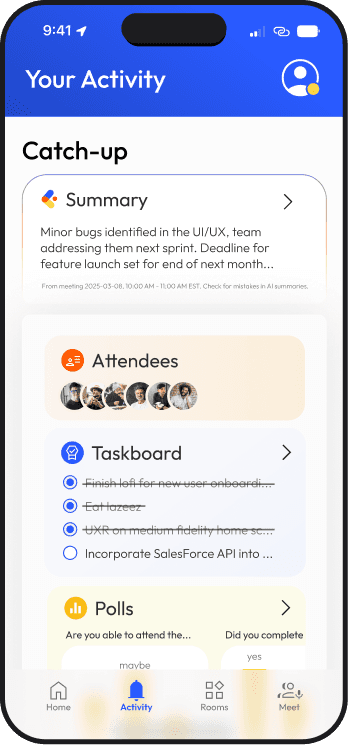

Rooms
A shared workspace per subteam holding whiteboards, docs, and polls, with Figma and other tools pulled in so work stays where the conversation is.
01
Onboarding that starts with the person
New hires fill out a short form on joining — department, a quick introduction, interests, and working hours — which becomes a profile everyone can see. It gives teammates a reason to reach out before there's a task to discuss.
02
Hangouts
Short, informal pairings scheduled automatically from shared availability and overlapping interests. Admins control how often they happen, and the format deliberately keeps work-talk out so the time goes to actual team bonding.
03
Overlap Hours Scheduler
A graph of every teammate's availability, converted into your own time zone, so you can see where the day genuinely overlaps and book a meeting people can actually attend.
04
Activity dashboards
After each meeting Overlap compiles a summary of the notes, who attended, poll and research results, and completed tasks — and tracks who has read it, so missing a call across time zones doesn't mean falling behind.
05
Rooms
A shared workspace per subteam holding whiteboards, polls, and documents, with Notion, Jira, and Figma pulled in so work stays where the conversation is.
Go-to-Market
This was the part I owned. Overlap's value grows with headcount, so acquisition, pricing, and expansion had to be designed as one system rather than three separate problems.
01
Acquire
Low customer acquisition cost meant borrowing existing trust rather than buying attention. The plan targeted young LinkedIn creators and founders with self-built communities — Michael Yan at Simplify, Eric Zhu at Aviato — alongside incubator partnerships with Y Combinator, Techstars, and 500 Startups that place Overlap inside cohort toolkits.
02
Convert
A freemium model with tiers mapped to company size: free up to 10 users, $10 per user for seed-stage teams up to 50, $15 for Series A up to 100, and custom pricing beyond that. Because the tiers track headcount, upgrading becomes a consequence of the customer growing rather than a sales conversation.
03
Expand
Integrations with Notion, Jira, and calendar tools make Overlap harder to leave, while referral mechanics — invite a founder, get three free months — and placements in creator newsletters keep acquisition running off the same communities that seeded it.
04
Launch timeline
Three phases: a closed beta across months one to three to secure early adopters and build credibility, a launch in months four to six built on growth campaigns and incubator exposure, then a post-launch push on free-to-paid conversion, SaaS integration, and sponsorship expansion.
Key Takeaways
Overlap was a business challenge as much as a design one, and the two kept pulling on each other in useful ways.
01
Distribution is a design problem too.
Working on go-to-market alongside the product changed what we built. Pricing tiers keyed to headcount meant the product itself had to make a team's growth visible, not merely possible.
02
Only the non-table-stakes features matter.
Slack and Teams already handle messaging, calls, and file sharing. Mapping that comparison made it obvious Overlap could only win on what they don't do — overlap hours, hangouts, automated onboarding — which sharpened the roadmap considerably.
03
Low acquisition cost comes from borrowing trust, not buying it.
Instead of paid acquisition, the plan leaned on founders who already held startup audiences and incubators that already had cohorts. This customer trusts peers far more than advertising, and the channel strategy had to reflect that.

POWERED BY POKE BOWLS
&& MANGO JUICE