
Back to Works
EcoBloom
Helping students build sustainable habits through playful, gamified experiences.
ECOBLOOM
Sustainable habits for students.


ROLES
Product Designer
Product Ideation
Research
TIMELINE
9 hours
TOOLS
Figma
Context
Sustainability on campus rarely fails for lack of caring — it fails for lack of convenience. Students want to make better choices, but the payoff is invisible: you never see what sorting your trash, skipping the Uber, or turning off a light actually adds up to. EcoBloom was designed to make those everyday actions visible, rewarding, and shared.
The Ask
How do we make sustainable habits a norm in our everyday lives?
/
The Convenience-First Student
ADRIEL — FIRST-YEAR STUDENT, MANAGEMENT ENGINEERING
GOAL
Shift his mindset and make more environmentally sound decisions — without giving up the convenience his schedule runs on.
NEEDS
To know which habits actually matter, and to see that the small ones are adding up to something.
PAIN POINTS
Ubers everywhere, doesn't sort his trash, over-buys groceries, and leaves electricity running.
User Research
We grounded the problem in campus data rather than assumption. Across waste, energy, and transport the numbers told the same story: the infrastructure to live sustainably already exists — everyday behaviour just hasn't caught up to it.
29.3%
of waste diverted from landfill — 2,887 tonnes still ends up there
63.8%
of electricity produced comes from carbon-intensive sources
3.3%
of vehicles used to commute to campus are electric or plug-in hybrid
The problem was never that students didn't care. It was that nothing made the impact of a single daily choice visible enough to be worth repeating.
Solution
EcoBloom is a gamified habit tracker: complete sustainable actions, earn points, and watch your plant grow in return — turning long-term environmental impact into progress you can see the same day.
Daily sustainability tasks
Four categories break sustainability into specific, point-scored actions — turning off unused lights, unplugging electronics — each with its own checkbox and reward.


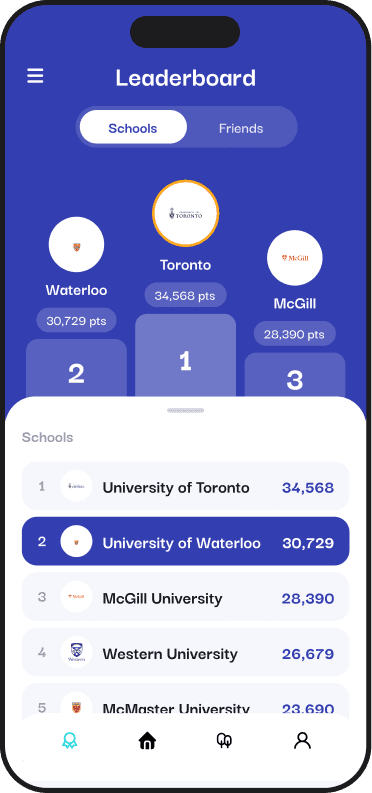
Community Garden and leaderboards
A shared garden grows as your pod completes actions, while school-versus-school rankings turn a private habit into campus-wide competition.
Get Involved
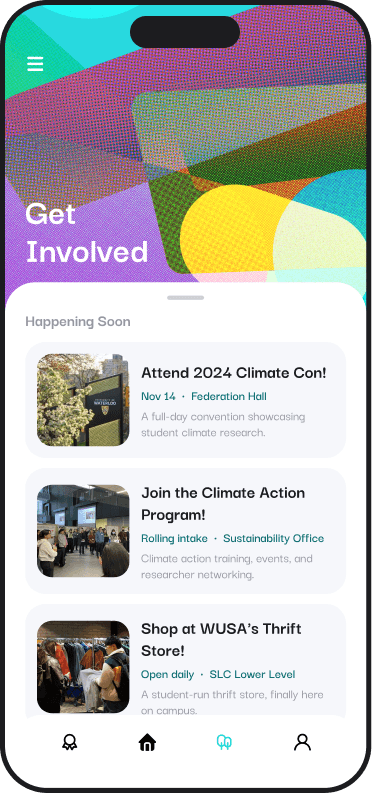
A feed of real campus opportunities — Climate Con, the Climate Action Program, WUSA's thrift store — alongside push reminders for daily actions.
01
Daily sustainability tasks
Four categories — energy, waste and recycling, water conservation, and food choices — break sustainability into specific, point-scored actions like turning off unused lights or unplugging electronics.
02
A plant that grows with you
Every completed task feeds your plant, giving immediate, tangible feedback for an impact that would otherwise stay invisible.
03
Community Garden and leaderboards
Students see the actions their peers are taking, while school-versus-school rankings turn a private habit into campus-wide competition.
04
Reminders and Get Involved
Push notifications prompt daily actions, and a Get Involved feed surfaces real campus opportunities — Climate Con, the Climate Action Program, and WUSA's thrift store.
Key Takeaways
Building EcoBloom on a designathon timeline reframed the problem for us: sustainability on campus is less a knowledge gap than a feedback gap.
01
Convenience beats conviction — so design for convenience.
People choose comfort over sustainability by default. The fix isn't persuading them to care more, it's lowering the cost of the better choice.
02
Invisible impact doesn't compound.
A plant that grows with every completed task turned a delayed, abstract payoff into feedback students could see the same day.
03
Community is what turns a habit into a norm.
The Community Garden and school-versus-school leaderboards made sustainability something students did alongside each other rather than alone — which is what moves a private habit into a shared expectation.

POWERED BY POKE BOWLS
&& MANGO JUICE